
 01 / The market
ManukaMan / Interactive adventure
The Color Trick
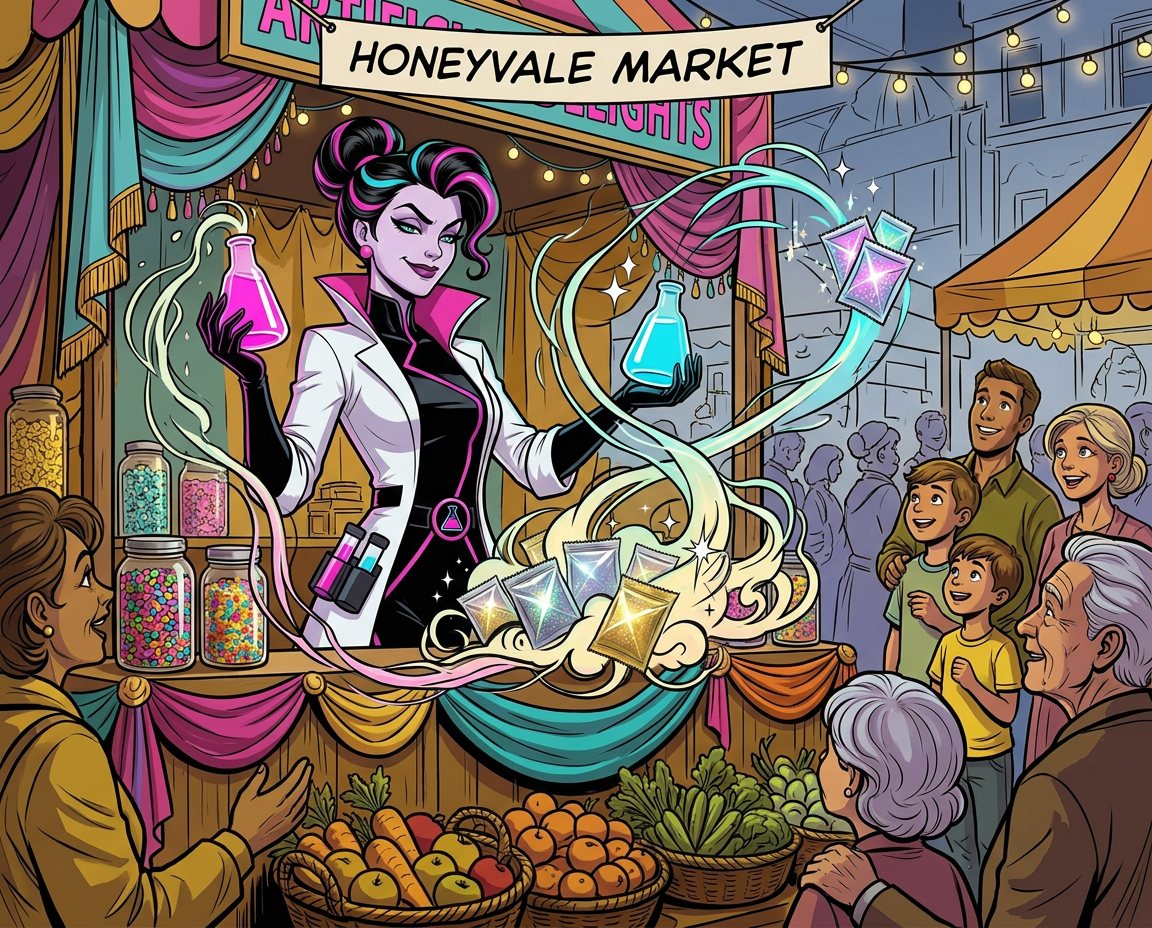
Lady Artificial has arrived at Honeyvale's market with glowing pink and cyan bottles. Her snacks look louder than fireworks. She wants everyone staring at the bright colors instead of asking what is inside.
The case file
THE COLOR CODE
Lady Artificial's tricks are pretend. These ingredient words are real — and they're clues to understand, not things to fear.
- E-number
- A short code used in Europe and the UK for a permitted food additive. It names an ingredient; it is not a danger score.
- E100 / Curcumin
- A yellow color from turmeric. An E-number can come from a plant.
- E300 / Vitamin C
- Ascorbic acid, also called vitamin C. It can help keep food fresh.
- E102 / Tartrazine
- A yellow food color. In the UK and EU, foods containing this color carry a warning about possible effects on activity and attention in children.
- Coloring
- An ingredient added to change how food looks. It may come from a plant or be made by another process; color alone tells us little about the whole food.
- Flavoring
- An ingredient added for taste or smell. Natural and manufactured flavorings both need to meet applicable food rules; a bright flavor is not proof of harm.
- Ingredients list
- The names of what's inside a packaged food, usually listed from most to least by weight. Ask a grown-up to help compare two snacks.
Parents & teachers
TALK IT THROUGH
Keep the conversation curious and shame-free. This story is about persuasive packaging and choices, not “good” and “bad” children or foods.
- What did Lady Artificial want everyone to notice? What did she hope they would miss?
- Can you find a color or flavor on a real ingredients list? What job might it do?
- Why can a food's color, taste and ingredients tell different parts of its story?
- What questions would you ask before deciding whether a snack suits your day?
WHAT THE EVIDENCE SAYS
An E-number identifies an additive authorized for use under relevant food rules; it is not a measure of how healthy a food is. Many additives have familiar names or natural sources. Food colors and flavorings serve different purposes, and an unfamiliar ingredient name is not a diagnosis.
Research on some mixtures of food colors and children's activity and attention found limited evidence of a small effect in some children; it does not show that every color, every additive, or every child is affected. UK/EU labels carry a warning for certain colors. Evidence does not support claiming that ordinary flavorings broadly cause behavioral problems. If a child appears sensitive, talk with a qualified health professional rather than imposing a broad restriction.
Look at the whole food and eating pattern, including added sugar, rather than treating any single E-number as a verdict. Food labeling rules vary by country.